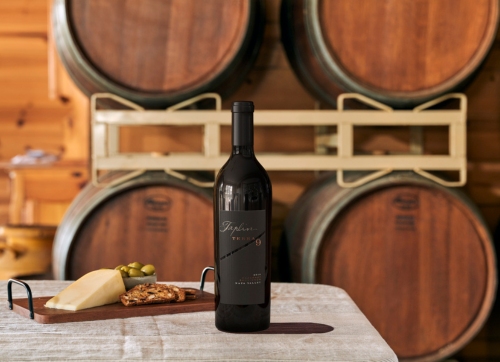
In honor of International Cabernet Sauvignon Day, September 3, 2026.
There are great places in the world to grow Cabernet Sauvignon. Bordeaux. Tuscany. Chile. Washington. But when most wine lovers think of Cabernet today, there is one place that immediately comes to mind: Napa Valley.
For us at Taplin Cellars, that connection is deeply personal. Our family has been rooted in Napa Valley for more than 160 years, and our estate sits on the western bench of St. Helena, at the foothills of the Mayacamas Mountains. It is a place where Cabernet Sauvignon doesn’t simply grow well, it seems to belong.
So, what makes Napa Valley so good for Cabernet? And why do we believe that the western bench is one of the very best places on the Valley floor to grow it?
It starts with the terroir: a remarkable combination of sun, warmth, cooling, and soil.
Napa Valley: A Natural Home for Cabernet Sauvignon
Cabernet Sauvignon likes a certain kind of challenge.
It needs plenty of sunshine to bloom and warmth to fully ripen its thick skins and naturally firm tannins. But too much heat can push ripening too quickly, resulting in wines that lose freshness and nuance. The magic happens when Cabernet gets enough warmth to develop deep fruit and ripe tannins while retaining the acidity that gives the wine energy and longevity.
Napa Valley has an extraordinary advantage here.
The Valley runs north to south, with mountains on either side and San Pablo Bay to the south. That geography creates a natural rhythm of warm, sunny days and cooling nighttime temperatures. Morning marine influence can slow the early part of the growing day, while abundant afternoon sunshine gives Cabernet the long, steady ripening it needs.
And as you move north through the Valley, the temperatures generally become warmer and the marine influence less pronounced. St. Helena sits in one of the warmest portions of the Valley floor—a particularly favorable environment for Cabernet Sauvignon to achieve full, expressive ripeness.
But temperature alone doesn’t make great Cabernet.
The soil matters just as much.
Why the Western Bench Matters
Walk across Napa Valley and you will find an incredible patchwork of soils. The mountains contribute volcanic and sedimentary material, while the Napa River and its tributaries have carried gravel, rock, sand, and silt onto the Valley floor over thousands of years.
Those alluvial deposits created what we now call the Napa benches.
For Cabernet Sauvignon, these sites can be particularly special because they tend to be well drained and relatively low in fertility. That forces the vines to work a little harder. Instead of producing excessive vegetative growth, the vines can devote more of their energy to their fruit.
And this is where Taplin’s own vineyard becomes especially interesting.
Our estate sits on the western bench of St. Helena, where our vineyards are planted in Bale gravelly loam. When we dug deeper into some of our Cabernet blocks, we discovered something remarkable: a deep layer of rocks associated with an ancient riverbed.
It was a clue to why that particular vineyard consistently produced smaller berries and lower yields.
And, more importantly, why the fruit tasted different.
We began fermenting the grapes from that vineyard separately, and the distinction was unmistakable. The fruit produced a Cabernet with greater concentration, depth, and structure, a wine that expressed not just the grape variety, but the particular piece of land where it was grown.
That wine became Taplin Cabernet Sauvignon.
Subsequently, we named that vineyard Ghost Creek Vineyard ®.
Warm Days, Cool Nights, and the Mayacamas
There is another piece of the puzzle that makes the western bench of St. Helena so compelling.
Our vineyard sits right at the base of the Mayacamas Mountains. That proximity gives the vines a different relationship with the sun and the surrounding landscape than you might find elsewhere on the Valley floor.
During the growing season, St. Helena receives plenty of warmth and sunshine, which is exactly what Cabernet needs to ripen fully. But our location also benefits from the influence of the mountains that provide late afternoon shade and the cool air that moves through the Valley at night.
At Taplin, we’ve seen this combination firsthand: warm days that build ripe, concentrated fruit, followed by cooler nights that help preserve freshness.
That balance is essential to the style of Cabernet we love.
We aren’t looking simply for a wine that is powerful. We want power with poise. Concentration with freshness. Ripe fruit with structure. And tannins that give the wine the ability to evolve for years in the cellar rather than simply making it feel heavy in its youth.
That balance is one of the signatures of great Napa Valley Cabernet, and one of the reasons we believe the western bench of St. Helena is such an extraordinary place to grow it.
What Makes a Taplin Cabernet?
For us, the answer is the land.
Our family has cared for this property for generations. We’ve watched the vineyards change, learned their quirks, and become increasingly curious about what each block is telling us.
Our Cabernet comes from a particular place on the western bench of St. Helena, where gravelly soils, an ancient riverbed, warm days, cool nights, and the protection of the Mayacamas all come together.
The result is a Cabernet that is deeply rooted in its sense of place: dark and concentrated, layered and expressive, with the structure to reward patience.
It is a wine shaped by Napa Valley, but more specifically, by our little corner of Napa Valley.
And that distinction matters to us.
Because Cabernet Day isn’t just an opportunity to celebrate one of the world’s great grape varieties. It’s an opportunity to celebrate the places that make Cabernet what it is.
For us, there may be no better place on the Valley floor to celebrate it than right here, on the western bench of St. Helena.
Happy Cabernet Day from Taplin Cellars!

Back to Recent Updates